Review Every Document.Miss Nothing.Move Fast.
Valify is an AI-powered document review assistant built specifically for UK construction RAMS. Upload a document and get a structured, severity-ranked report in under 5 minutes — flagging every gap, missing section and cross-document inconsistency your team would otherwise have to find manually. Valify works alongside your team. Every flag it raises is a judgement call only your people can make.
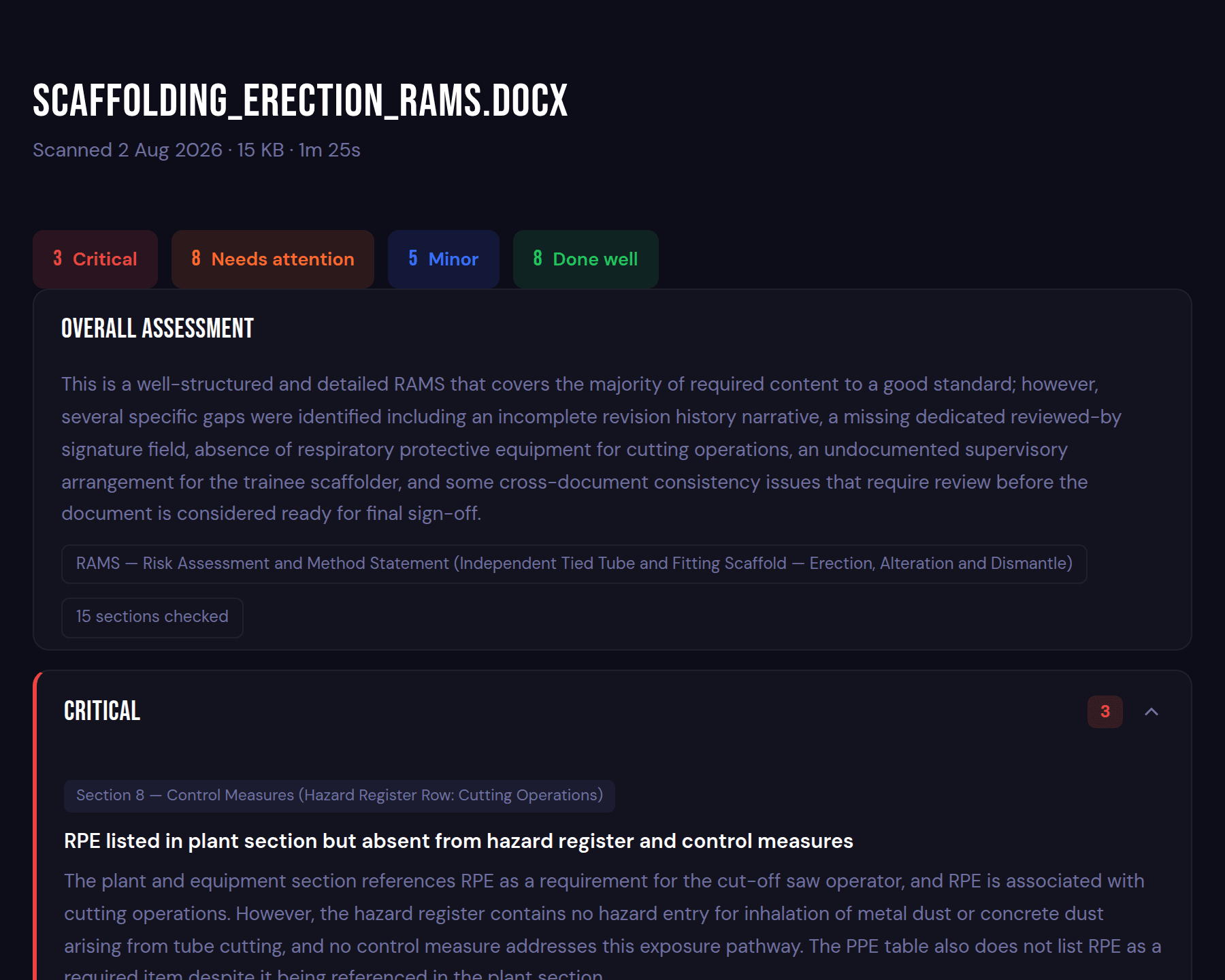
Here is what manual RAMS review actually costs your team.
Your H&S Manager Is Reading The Same Document For The Hundredth Time.
Every RAMS document that lands on a health and safety manager's desk gets the same treatment. Fifteen-plus sections, read in full, cross-checked against each other, judged against a standard that doesn't loosen just because it's document ninety of the month. A single document takes 45 to 90 minutes to read properly, so a dozen of them in a week is most of two working days — days that could go on site, on training, on the judgement calls only a qualified human can make. Most teams don't have that time to spare, so review gets squeezed into whatever gap is left in the day. That gap usually lands right when fatigue is highest.
Fatigue does more damage here than competence ever could. The tenth document of the day gets a lighter read than the first, and it isn't because anyone stops caring. Sustained, section-by-section attention to dense technical text simply wears down over hours. A control measure that reads "take care and be aware of surroundings" slips through because there are nineteen more documents waiting and the deadline was yesterday. It isn't a training problem. It's a structural one, and it's precisely the kind of gap that surfaces during an HSE investigation, long after fixing it would have been cheap and easy.
What Happens When Something Gets Missed.
A gap in a RAMS document is never just paperwork. It carries a real risk, and that risk escalates fast once work starts on site.
HSE Investigation
A missed control measure that contributes to an incident doesn't just trigger scrutiny of that one document — it invites the HSE to examine every RAMS your business has produced, on every site, for as far back as they choose to look.
Investigators specifically look for exactly the kind of gap manual review under time pressure tends to miss: a hazard without a matching control, PPE doing the job engineering controls should have done, a vague instruction standing in for a specific one.
Site Shutdown
An auditor who finds one inadequate RAMS document on site rarely stops there — the standard response is to halt related works until every document in that category has been reviewed and corrected, which can take days, not hours.
Every trade waiting on that activity to finish sits idle in the meantime. On a live programme with multiple dependent trades, a single document gap can cascade into a delay measured in weeks, not days.
Legal Liability
After any serious incident, the first documents a solicitor requests are the RAMS in place at the time. Gaps discovered there — inconsistencies between the hazard register and the control measures, or vague language where specificity was required — become the basis of the claim.
Directors carry personal exposure under the Health and Safety at Work Act. A documented gap that a reasonably thorough review should have caught is precisely the fact pattern that turns a site incident into a personal liability case.
Upload. Analyse. Report. Decide.
Four steps, no setup, and a structured report before your coffee goes cold.
Upload your document
Drag a RAMS document into the upload zone — PDF or Word both work. Add a note if there's something site-specific you want checked with extra care. No templates. No formatting requirements. No setup.
Valify reads every section
Every section gets checked on its own first, against what a thorough reviewer would look for. Then Valify cross-checks them against each other: hazards against scope, controls against hazards, PPE against controls, plant against the hazard register.
Get a structured report
You get a full report in under 5 minutes, ranked Critical, Needs Attention and Minor. It also shows what the document already gets right. Every flag carries a section reference and the reasoning behind it, ready for your team to act on.
Accept or return the document
Once your team has reviewed the findings, record your decision directly in Valify. Accept the document — logging who approved it, when and what the report contained at that moment — or return it for revision. Every decision goes into your audit trail and cannot be edited afterwards.
See It In Action
From upload to full report in under 5 minutes.
- 01UploadDrag in a PDF or Word file. No template, no setup.
- 02ScanEvery section read, then cross-checked against the rest.
- 03ReportSeverity-ranked, with a section reference on every flag.
What You'll See In Your First Free Scan
Not a demo and not a cut-down preview — the free scans produce the same report a paying customer gets. Here is what lands, in order.
- 1
Four counts, before anything else
Critical, Needs Attention, Minor and Done Well. You know the shape of the document before you read a word of the report — and whether it needs you today.
- 2
Every finding with its section reference
Not “the hazard section is weak”. The section it is in, what is missing from it, and what a thorough reviewer would have expected to find there.
- 3
The reasoning, on every flag
Each finding carries a “why this matters” you can open — so you can disagree with it. Valify raises the question; the judgement stays with your team.
- 4
A report you can file or send
Download it as a PDF, or share a read-only link with the principal contractor. The sample below is a real one: 11 pages, 24 findings.
Every scan checks all RAMS sections.
Project Details
Site, client and principal contractor details are present, correct and consistent.
Scope of Works
Activities described specifically enough to identify hazards against, not in vague generalities.
Personnel
Named roles, qualifications and responsibilities for every person on the job.
Plant & Equipment
Every item of plant in scope also appears in the hazard register.
Materials & COSHH
Hazardous substances identified with COSHH assessments matching materials in scope.
Hazard Identification
Every hazard implied by the scope of works has a corresponding entry.
Risk Assessment
Likelihood and severity scored consistently, before and after controls.
Control Measures
Every hazard has a specific, actionable control — not a vague instruction.
PPE Requirements
PPE matches identified hazards and follows engineering controls, not replaces them.
Emergency Procedures
Site-specific muster point, first aider and nearest hospital, not a generic template.
Environmental Considerations
Noise, dust, waste and watercourse risks addressed with specific mitigations.
Communication & Briefing
A defined process for briefing the document to every operative before work starts.
Legislation References
Correct, current regulations cited — not superseded guidance.
Signatures & Sign-Off
Every required signature present and dated before work is scheduled to start.
Review & Revision History
Revision history current and specific to this project, not a reused template.
Cross-document consistency checks
Beyond checking each section individually, Valify cross-references the whole document — verifying that every hazard in Section 6 has a control measure in Section 8, that every item of plant in Section 4 appears in the hazard register, and that PPE requirements match the specific hazards identified rather than being applied generically.
Document Decision Log
Every document your team reviews through Valify carries a decision record that cannot be edited afterwards — who accepted it, when, and what the report said at that point. If a document is returned for revision, that is logged too. Your team has a complete, timestamped audit trail of every review decision, ready if it is ever needed. It is kept alongside the document, and deleted with it after 90 days.
Three Documents. Every Issue Found.
A scaffolding RAMS, a roofing method statement and a demolition risk assessment — the same review, on three different kinds of document. Open a finding to see the reasoning behind it.
Every scan sorts what it finds into four severity levels, so your team always knows where to look first.
Must be fixed before use
Missing control measures for identified hazards, absent emergency procedures, or contradictions serious enough that the document isn't suitable for site until resolved.
Should be improved before use
Vague control measures, PPE standing in for engineering controls, or plant and materials that don't match across sections — weak points, not guaranteed failures.
Would improve document quality
Outdated revision history, superseded legislation references, or inconsistent numbering — not safety-critical, but worth tidying up on the next revision.
Complete and well-structured
Sections that meet the standard in full are called out too — so your team can see what's already working, not just what isn't.
Scaffolding_Erection_RAMS.docx
Why it matters: Without a hazard entry, a risk rating and a control measure following the hierarchy of control, the document gives no assurance the exposure was ever assessed or communicated to operatives.
Why it matters: CISRS trainees must work under direct supervision at all times. With no named supervisor in the RAMS there is no auditable assurance that happened during high-risk erection work.
Recommended improvement: Update the reference to EN ISO 20471:2013+A1:2016 so operatives and procurement are directed to current-standard PPE.
Why it matters: Sections that meet the standard in full are reported too, so your team can see the review covered the whole document — not only the parts with problems — and knows what it does not need to spend time on.
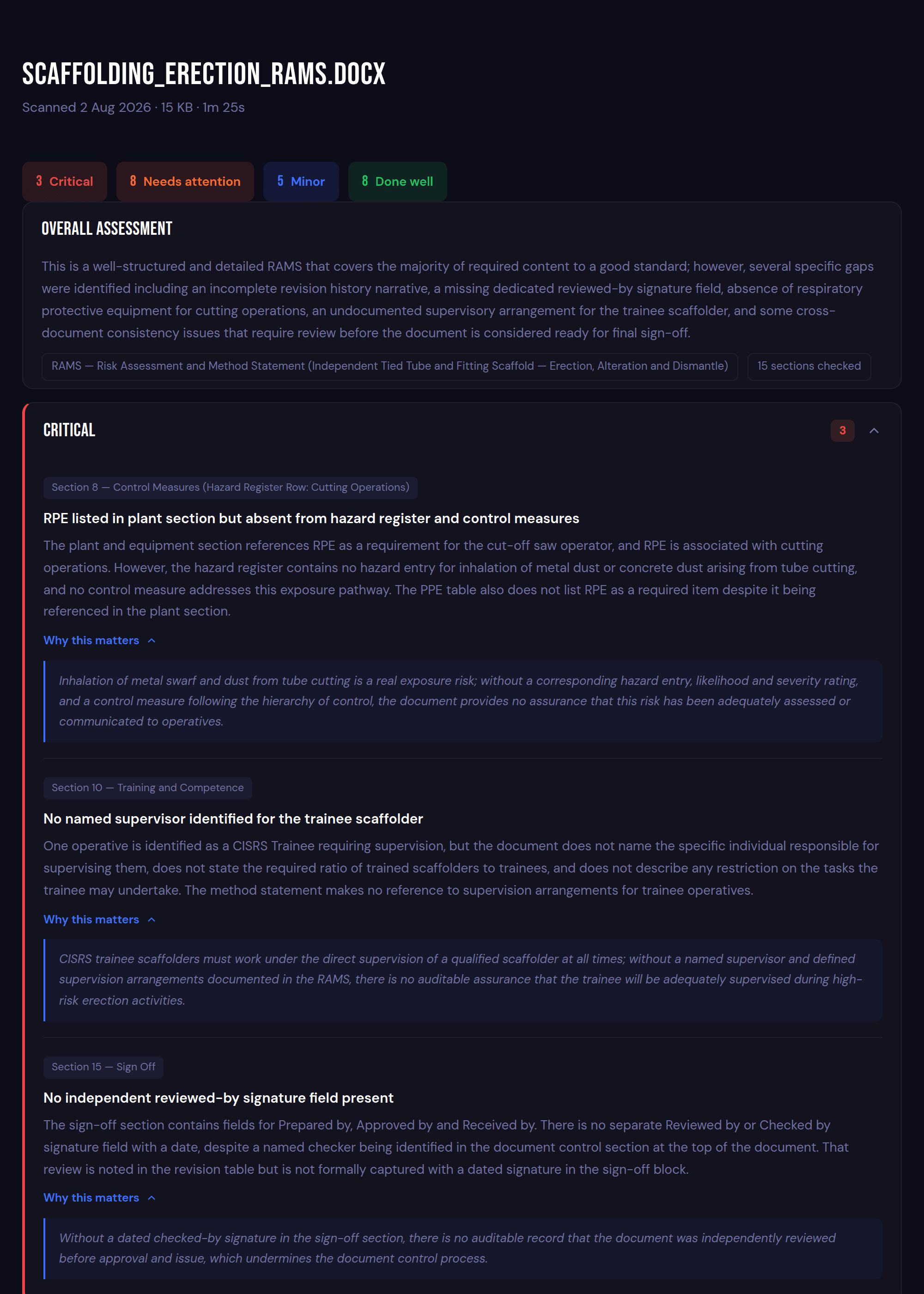 Preview — 11 pages, 24 findings
Flat_Roof_Waterproofing_Method_Statement.pdf
Why it matters: A naked flame on a combustible deck is the highest-consequence hazard in this task. With no hot works permit and no post-work fire watch stated, nothing in the document shows the ignition risk was controlled.
Why it matters: "Where required" leaves the decision to whoever is on the roof that morning. A fragile surface shown on the drawing but absent from the risk assessment is the specific gap that falls through roof lights keep being caused by.
Recommended improvement: Give the numbers. A stated maximum wind speed and minimum substrate temperature can be checked on site; "adverse" cannot, so in practice the call is made under time pressure.
Why it matters: Treating the enclosed area as its own case, rather than applying one set of controls to the whole job, is the part most COSHH sections skip.
A worked example in the format Valify produces. The full downloadable sample report is the scaffolding RAMS.
Soft_Strip_Demolition_Risk_Assessment.docx
Why it matters: Those are two of the most common locations for asbestos-containing materials in a building of this age. Without the survey result recorded in the document, operatives are being sent to disturb them on an assumption.
Why it matters: A verbal confirmation is not an isolation. Without lock-off and a proving step recorded in the method, there is nothing preventing a circuit being re-energised while operatives are cutting into it.
Recommended improvement: State the weight above which a load is a two-person lift, and record why a chute or a hoist was ruled out — the hierarchy expects the mechanical option to be considered first, not the last resort.
Why it matters: Naming the drawing revision is what makes this checkable later. A reference to "the engineer’s drawing" with no revision is the version that gets superseded quietly.
A worked example in the format Valify produces. The full downloadable sample report is the scaffolding RAMS.
Core Sections. Every Row. Every Scan.
No section gets skipped because it "usually is fine." Here's exactly what Valify checks in each one.
Project Details
- Site address and client match across the document
- Principal contractor named and correct
- Project reference number consistent throughout
Manual reviewers often skim this section assuming it's boilerplate — Valify checks it every time regardless.
Scope of Works
- Activities described as a specific, ordered sequence
- Scope matches what's referenced elsewhere in the document
- No generic language standing in for site detail
A common miss: scope updated late in drafting while hazards still reference the old version.
Personnel
- Site supervisor and first aider named, not just titled
- Relevant qualifications listed for named operatives
- Headcount matches the scale of works described
Manual review often accepts job titles alone — Valify checks that named individuals actually appear.
Plant & Equipment
- Every item of plant in scope appears in the hazard register
- Maintenance and inspection status referenced
- Operator competence requirements stated
Reviewers frequently miss plant added to scope after the hazard register was finalised.
Materials & COSHH
- COSHH assessments present for every hazardous material
- Materials listed in scope match those in COSHH
- Storage and disposal requirements addressed
A common gap: a material named in scope with no matching COSHH assessment anywhere.
Hazard Identification
- Every activity in scope has a corresponding hazard entry
- Hazards specific to this site, not a generic list
- No hazard implied by plant or materials left unlisted
Manual reviewers tend to check the list exists, not whether it matches the actual scope.
Risk Assessment
- Likelihood and severity scored before and after controls
- Residual risk stated explicitly for each hazard
- Scoring applied consistently across the document
A frequent miss: residual risk scores left blank after control measures are added.
Control Measures
- Every hazard has a specific, actionable control measure
- No vague language such as "take care" or "be aware"
- Hierarchy of control followed before PPE is relied on
The most commonly missed gap of all — vague wording standing in for a specific action.
PPE Requirements
- PPE matches every hazard identified, not a generic list
- PPE positioned as last line of defence, not first
- Standards and specifications named where relevant
Reviewers often accept PPE lists without checking they follow engineering controls first.
Emergency Procedures
- Named muster point specific to this site
- Nearest hospital named, not "the nearest hospital"
- Named first aider and emergency contact numbers
A common miss: a muster point copied straight from a previous site's template.
Environmental Considerations
- Noise, dust and vibration mitigations specific to the works
- Nearby watercourses or protected areas addressed
- Waste management and disposal route stated
Nearby watercourses are frequently missed when they sit just outside the site boundary.
Communication & Briefing
- A defined process for briefing the document to operatives
- Sign-off confirming briefing has taken place
- Process for briefing changes mid-project
Manual review rarely checks that briefing sign-off predates the actual start of work.
Legislation References
- Regulations cited are current, not superseded
- References relevant to the specific activity described
- CDM 2015 referenced correctly where applicable
A common gap: guidance documents cited that were withdrawn or superseded years ago.
Signatures & Sign-Off
- Every required signature present and dated
- Sign-off predates the scheduled start of works
- Authority of each signatory appropriate to their role
Reviewers often miss signatures dated after work was already scheduled to begin.
Review & Revision History
- Revision history current and specific to this project
- No leftover references to a previous site or client
- Review date consistent with project timeline
The easiest tell of a reused template — revision dates that don't match this project.
Valify vs. Manual Review.
No made-up percentages — just the specific differences that matter.
| What matters | Manual Review | Valify | What Goes Wrong Without It |
|---|---|---|---|
| Review time per document | ✕ 45–90 minutes | ✓ Under 5 minutes | 20+ hrs/week across a busy compliance team |
| Consistency across every section | ✕ Degrades with fatigue | ✓ Identical on scan 1 and scan 250 | Standards silently drift between reviewers over time |
| Catches fatigue-related misses | ✕ No — human attention varies by hour | ✓ Same standard, every time | Late-day reviews get progressively less thorough |
| Available 24/7 | ✕ Business hours only | ✓ Any time, any day | Urgent submissions wait until someone's back at their desk |
| Flags cross-document inconsistencies | ✕ Easy to miss across long documents | ✓ Checked automatically, every scan | Contradictions surface only when someone asks the wrong question |
| Severity-ranked output | ✕ Reviewer's own notes, if any | ✓ Critical / Attention / Minor / Done Well | Everything looks equally urgent, or nothing does |
| Downloadable report | ✕ Rarely standardised | ✓ PDF and Word, every scan | No consistent record of what was actually reviewed |
| Cost per document | ✕ ~£52 in reviewer time (90 min @ £35/hr) | ✓ £58.33 on Starter · £9.00 on Growth | ≈£36,400 a year in review time at 20 hrs/week and £35/hr |
Scroll the table sideways to see every column.
Simple Plans. No Setup Fees.
Every plan starts with 3 free scans. Pick the plan that matches your document volume.
Starter
For teams getting manual review off their plate for the first time.
- 30 document scans per month
- RAMS documents only
- Standard processing queue
- PDF report download only
- Complete document history
- Document decision log with timestamped audit trail
- Shareable read-only report linksGrowth and Enterprise
- Team notification emailsGrowth and Enterprise
- Email support within 48 hours
- Monthly rolling contract — cancel anytime
Growth
For HSEQ teams reviewing volume across multiple sites.
Less than 20 minutes of an H&S manager's time, per document reviewed.
- 250 document scans per month
- RAMS, Method Statements and Risk Assessments
- Priority processing — faster queue than Starter
- PDF report download
- Editable Word report download
- Complete document history
- Document decision log with timestamped audit trail
- Shareable read-only report links
- Team notification emails — up to 5 addresses
- Priority email support within 12 hours
- Monthly rolling contract — cancel anytime
Enterprise
For principal contractors and multi-site operators at scale.
- Unlimited document scans
- All document types plus custom categories
- Dedicated processing — guaranteed response time
- PDF, Word and CSV data export
- Document decision log with timestamped audit trail
- Shareable read-only report links
- Team notification emails — unlimited addresses
- Custom branded reports with your company logo
- API access and webhooks for system integration
- Dedicated account manager and phone support
- Full team training session included
- Annual contract
Tailored pricing for teams with high document volume or specific integration requirements.
Talk to UsNot ready to pick a plan?
Run three documents through it first — real ones, from a live job. No card, no sales call, and the reports are the same ones a paying customer gets. Decide on the plan when you have seen what it finds.
All prices are shown excluding VAT and are in pounds sterling. VAT is calculated and added at checkout according to your billing address, and itemised on every invoice. Annual plans are billed as a single payment covering twelve months’ access. Monthly plans are a rolling contract you can cancel at any time from your account.
Questions Construction Compliance Teams Ask.
On Starter, Valify reviews RAMS (Risk Assessment and Method Statement) documents specifically. Growth adds Method Statements and Risk Assessments submitted as standalone documents, and Enterprise extends coverage to all document types your team produces, including custom formats agreed with your account manager.
No, and it's not designed to. Valify is a document review assistant, not a replacement for qualified health and safety personnel. It performs the first, exhaustive read of every document and flags potential issues by severity — but every final decision on whether a document is adequate for use remains entirely with your team. That division of labour is permanent, not a stepping stone toward automation.
Once you've read the concerns Valify raised, you decide what happens next. Accepting the document records your decision against it — who accepted it, when, and what the report said at that moment — and saves it to your list as accepted. It is not Valify approving the document, and an acceptance record is not evidence of compliance. If you don't think the document is ready, you're under no obligation to accept it: revise it and submit it again, or leave it awaiting a decision.
Valify is built to catch common and structural gaps — missing controls, inconsistent cross-references, vague language — but it does not guarantee completeness and should never be treated as a substitute for professional judgement. That's precisely why sign-off always sits with your qualified personnel: Valify makes the reading faster and more consistent, it does not make the decision for you.
Yes. Documents are encrypted in transit using TLS 1.2+ and encrypted at rest in Supabase Storage. Content is routed through OpenRouter to the AI model (currently Anthropic's Claude) strictly to generate your report — never used to train models — and is permanently deleted 90 days after upload. Access is restricted to the automated processing pipeline and a small number of authorised support staff.
You get 3 free document scans with no payment details collected at sign-up — one free trial per company. Once all 3 scans are used, your account pauses and you're prompted to choose a paid plan to continue reviewing documents.
Yes. Starter and Growth run on monthly rolling contracts, cancellable at any time from your account settings with no penalty, effective at the end of the current billing period. Enterprise runs on an annual contract agreed directly with your account manager.
PDF and Word (.doc/.docx) documents up to 50MB per file, one file per scan. A document over 50MB is usually large because of embedded photographs rather than text, so re-exporting it at a lower image quality normally brings it under the limit. Any other file type is rejected immediately with a clear error message, as are zero-byte files and PDFs that contain no readable text.
Most documents return a complete, structured report in under 5 minutes. Longer or unusually complex documents may take slightly more time, but you'll always see live progress on screen while the analysis runs.
Yes. Core health and safety legislation relevant to construction — including CDM 2015 — applies UK-wide, and Valify's checks reflect that. Valify is also used by teams in the US, Canada and Australia, with checks grounded in the same hierarchy-of-control principles that underpin best practice internationally.
RAMS stands for Risk Assessment and Method Statement — a legally required document in UK construction that identifies the hazards associated with a piece of work and sets out the method by which that work will be carried out safely, including control measures, PPE and emergency procedures.
Yes. The upload flow, progress tracking and full report all work in any modern mobile browser, so you can start a scan or check on a result from site. For reading a long report in detail we'd still recommend a tablet or desktop screen, simply because RAMS documents are dense and easier to scan properly on a larger display.
Valify reads for content, not a fixed template — it identifies all sections wherever they appear and in whatever order or heading style your business uses, including documents with non-standard numbering, merged sections or company-specific formatting. If a section genuinely can't be located, it's flagged as missing rather than silently skipped.
No questions match your search. Try a different term.
3 Free Scans. No Card. No Commitment.
Create an account, upload a document you're confident is clean or one you're not sure about, and see exactly what Valify finds. Nothing charged to any card.